Grant’s 10 Favorite Books of 70 Read in 2023!

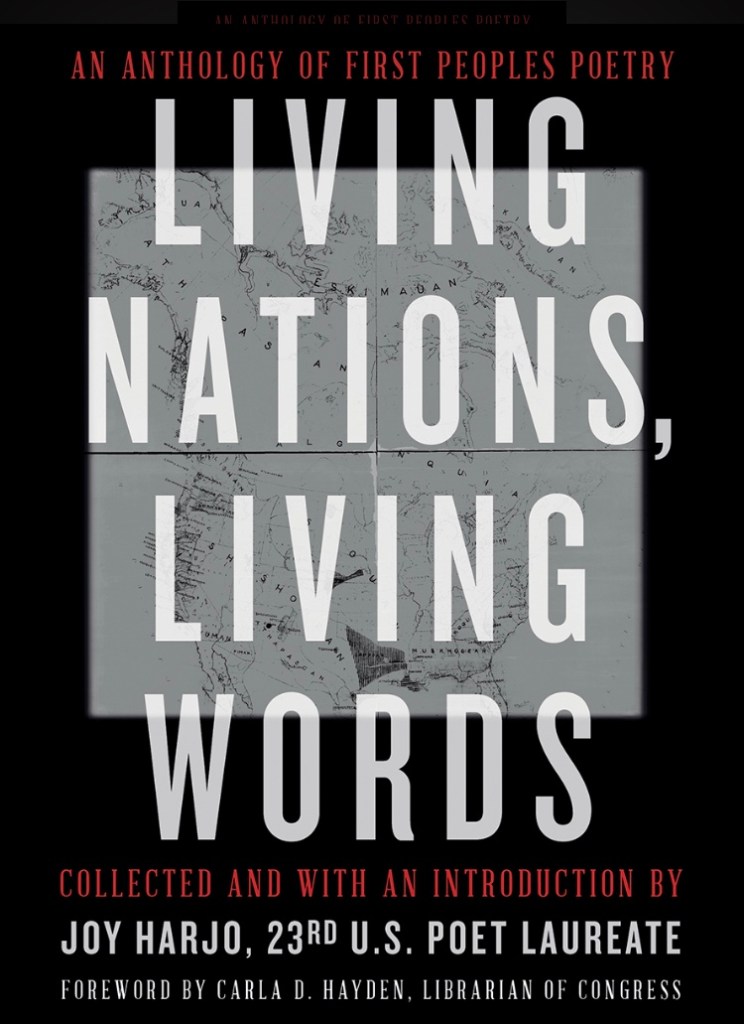
1. When the Light of the World Was Subdued, Our Songs Came Through: A Norton Anthology of Native Nations Poetry, edited by Joy Harjo, with LeAnne Howe and Jennifer Elise Foerster

2. Poet, the Warrior, the Prophet, by Rubem Alves

3. Decolonial Christianities: Latinx and Latin American Perspectives, edited by Raimundo Barreto and Roberto Sirvent

4. Reading and Writing the Lakota Language, by Albert White Hat Sr.

5. Healing Haunted Histories: A Settler Discipleship of Decolonization, by Elaine Enns and Ched Myers

6. Galatians: A Theological Commentary on the Bible, by Nancy Elizabeth Bedford

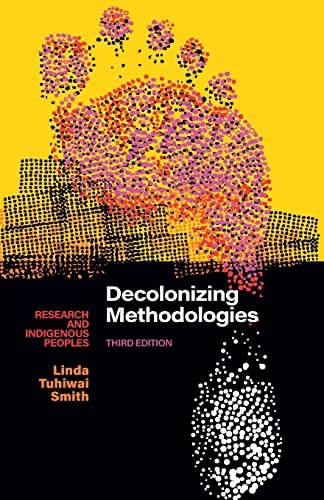
7. Decolonizing Methodologies: Research and Indigenous Peoples, by Linda Tuhiwai Smith

8. Complaint!, by Sara Ahmed

9. Faith and Freedom in Galatia and Senegal: The Apostle Paul, Colonists and Sending Gods, by Aliou Cissé Niang

10. Trading Futures: A Theological Critique of Financialized Capitalism, by Filipe Maia

Book Review: “So We and Our Children May Life: Following Jesus in Confronting the Climate Crisis” by Sarah Augustine and Sheri Hostetler

I recently had the opportunity to read and write the study guide for Sarah Augustine and Sheri Hostetler’s new book, So We and Our Children May Live: Following Jesus in Confronting the Climate Crisis. You can find the study guide on this website under the “S” titles: https://heraldpress.com/study-guides/. Reading this text was both a challenge and an inspiration. As Patty Krawec states in the forward, “In addition to laying out the stark realities of our circumstances, Sarah and Sheri have also laid out strategies for that confrontation. Things that we can and should do, things we can and should demand” (11). Consequently, this book is a prophetic naming of the disastrous realities of the global climate crisis, while also being a practical guide for responding to this present nightmare.

Augustine and Hostetler approach this collaborative work together, bringing their full identities to bear as North Americans: Augustine as a Pueblo (Tewa) descendant and Mennonite; Hostetler as a descendant of Swiss Amish Mennonite farmers. Through this collaborative dialogic, Augustine and Hostetler name the process of confronting the climate crisis as the work of decolonization, solidarity, and survival. They strive to accomplish this work by structuring the book into three parts.

The first part contrasts the lived experiences of “Reality” versus the web of lies spun by the global extractive logic of “reality.” As Christians, Augustine and Hostetler connect “Reality” with God’s kingdom vision for the world: past, present, and future. In the second part of the book, Augustine and Hostetler interrogate popularized approaches to climate change through the “Green Growth” movement and reveal the deadly limitations of these initiatives. Finally, in the third part, Augustine and Hostetler propose an alternate vision of ecological justice and right relationship by providing tangible steps toward co-creating a decolonized future.

Augustine and Hostetler provide a compelling and practical case that both names Reality and offers practical steps toward co-creating a just future for all people and creation. As Augustine and Hostetler reveal, the stakes are great: “We can imagine and choose a life-sustaining, just civilization, or we can continue business as usual. Life and death. What’s good and what’s wrong. That is our choice” (26). My hope and prayer is that this book, and the discussions sparked by it through conversations, reading groups, and study-guide engagement, can lead us toward action in choosing life. Amen.

Book Review: “Beguiled by Beauty: Cultivating a Life of Contemplation and Compassion” by Wendy Farley

Beguiled by Beauty: Cultivating a Life of Contemplation and Compassion by Wendy Farley is a practical exploration of the practice of contemplation and attentiveness to beauty. Farley makes this connection between contemplation and beauty by first emphasizing that “the core practice of a contemplative way of life is radical compassion….A contemplative way of life is motivated by a devotion to the welfare of others” (7). While contemplation is primarily practiced through interior work and discipline, Farley notes that such interior work is oriented toward relationality. This relationality originates, and is rooted, within the Divine. From this rootedness within the Divine Beloved, the interior work of contemplation then radiates outward as radical compassion for all creation.

With this understanding of the communal nature of contemplation and its interior work, Farley then defines beauty. She defines beauty as “the threshold to Divine Goodness and a door into radical compassion. When we fall in love with the beauty of the world, we care all the more passionately about the well-being of the environment and all of the beings in the world” (16). Since attentiveness to beauty connects humanity with the Divine Goodness of God’s creation, leading humans into radical compassion and care for that creation. Consequently, this attentiveness to beauty, according to Farley, is a crucial tool of contemplation. From this synthetic framework of the interior work of contemplation and attentiveness to beauty, rooted in relationality with Divine Goodness, leading to radical compassion amidst of all of creation, Farley structures the contents of Beguiled by Beauty.

Following the first introductory chapter where Farley establishes this framework, chapters 2-3 elaborate this framework in greater detail. Chapters 4-7 provide general examples of the synthetic framework between contemplation and beauty, while also noting benefits and challenges within this framework. In the eighth chapter, Farley concludes with practical examples of contemplative practices that offer opportunities to be attentive to beauty within everyday life.

Beguiled by Beauty successfully achieves Farley’s goal of providing a theoretical and practical approach to contemplative practice that is attentive to beauty so that individuals can draw deeper into God’s Divine Goodness and bear fruits of radical compassion toward all of compassion. However, a greater exploration into the role of privilege within practices of contemplation would have made this text stronger. For example, Farley states that “the causes of well-being and unhappiness lie deep inside us and we share them without knowing it” (10). While this statement rings with truth, so too do systematic and structural injustice and marginalization dramatically and tangibly impact lived experiences within all of creation. Consequently, a nuanced discussion of the role of privilege and oppression, and their consequent impact on access to contemplation, would have made the argument of this text stronger.

Review of “God Will Be All in All: Theology through the Lens of Incarnation” by Anna Case-Winters

Check out my review of Anna Case-Winters’ book, God Will be All in All: Theology through the Lens of Incarnation,” in the latest issue of Religious Studies Review, Volume 49, through Rice University: https://onlinelibrary.wiley.com/share/author/NVHF3F7URZYBKBY6EBF6?target=10.1111/rsr.16391

Review of ‘Indigenous Theology and the Western Worldview: A Decolonized Approach to Christian Doctrine’ by Dr. Randy Woodley

https://link.growkudos.com/1m8wk8nxxq8

This article I wrote for Wiley Author Services provides a brief summary of Dr. Randy Woodley’s text, ‘Indigenous Theology and the Western Worldview: A Decolonized Approach to Christian Doctrine.’ The review can be a helpful resource if you are trying to decide if you want to read this text. Dr. Woodley’s text is helpful if you are curious about the juxtaposition and mutual learnings between Indigenous Theology and a Western Worldview or decolonial approaches to Christian Doctrine.

My Top 10 Books of 2022

I have completed my Goodreads 60 books in 2022 challenge: https://www.goodreads.com/user/year_in_books/2022?ref=yyib_dec_22_yyib_eml?rto=x_gr_e_nf_yyib22&utm_medium=email&utm_source=yyib&utm_campaign=2022&utm_content=spotlight1&ref_=pe_3496280_680573190

As a result, I wanted to identify my favorite 10 books. Here they are listed in order:

1.

2.

3.

4.

5.

6.

7.

8.

9.

10.

Honorable Mentions

11.

12.

‘Why Do the Nations Rage? The Demonic Origin of Nationalism’ by David Ritchie Book Review

Why Do the Nations Rage?: The Demonic Origin of Nationalism by David A. Ritchie

My rating: 5 of 5 stars

“It is crucial for Christians to clearly recognize the distinction between rightly ordered patriotism and idolatrous nationalism; to recognize the difference between gratitude to God for one’s nation and the temptation to worship one’s nation as a god. None of us are above this temptation. Sadly, the people of God have had a long history of looking to political power for salvation. We have a long history of crying out the name of insurrectionist ‘Barrabus!’ instead of the name of the Prince of Peace, who alone has the power to make all things new. The powers are real, and they are greedy for our affection. Yet the exhortation of Joshua 24 still applies to the people of God today. We must put away the gods of our fathers and the gods of the nations. We must choose this day who we will serve” (142).

This book is deeply relevant, contextual, and a must read for the perilous time in which we live in the United States. Ritchie asks the question ALL people who call themselves Christians need to ask: who do we serve/pledge our allegiance? Christ? Or the United States?

‘Why do the Nations Rage? The Demonic Origin of Nationalism’ by David Ritchie is a contextual and relevant unpacking of the idolatrous and demonic power of nationalism, particularly in how it has co-opted a façade of Christianity to justify itself. Ritchie shows that christian nationalism is a paradoxical identity because “nationalism involves the exaltation of a nation (or a particular conception of a nation) to the highest place of allegiance, concern, and devotion, [thus] it is essentially idolatrous” (6). Nationalism cannot be Christian because it is inherently idolatrous. Furthermore, Ritchie shows that while the January 6, 2021 Capitol Riot is a contemporary manifestation of nationalism, nationalism has ancient roots and is generally demonic: “when examined through the lens of biblically demonology, you will discover that there is little distinction between the ancient pagan’s worship of national patron deity and the contemporary nationalist’s tendency to exalt a particular nation to a place of functional divinity” (6). As a result, Ritchie argues that “nationalism-not atheism, not new age spiritualism, nor any other traditional world faith-is the greatest religious rival to the Christian gospel that vies for the worship of [God’s] people….seek[ing] to conquer Christianity, or…to co-opt Christianity for its own purposes” (6).

Ritchie accomplishes this goal through five sections in this book.

The first section carefully describes how the New Testament writings of Paul use the terms ‘powers,’ ‘principalities,’ ‘authorities,’ and other terms to describe “spiritual beings that are personal in nature and exert corporate influence over groups of people….and geographical territories” (9), including ‘nations.’

Ritchie then summarizes these demonic ‘spiritual beings’ under the umbrella term ‘powers’ and explains how these ‘powers’ were the reason why the God of the Old Testament/New Testament condemned ‘pagan nations’ and ‘national patron deities’ in the second section.

In the third section, Ritchie shows that Christ has defeated all demonic forces of evil through his life, death, and resurrection. Thus, Christ has not only defeated our reliance upon the ‘powers,’ but has commanded us to resist these powers. Christians cannot simply ignore or turn a blind eye to the idolatry of nationalism, but we must name, denounce, and resist the evils of nationalism through primacy of devotion to Christ and the transformative work of the Holy Spirit.

In order to accurately name the evils of nationalism today, so that Christians can denounce and resist them, section four describes how nationalism has co-opted a façade of Christianity and created a systematic theology of nationalism” (93). In short, this theology of nationalism primarily “stands against the first commandment and the Christian understanding of God as the one to whom highest praise and devotion belongs…[through] the belief that ‘loyalty to the nation overrides all other loyalties'” (95). Some modern examples include the symbols of “Columbia (or Freedom) as the patron goddess of the United States….flags function[ing] beyond a mere identifying symbol of a nation, and instead having been imbued with sacred significance and accorded ritualistic worship”(97), the pledge of allegiance in schools, national art that uses Christian imagery, ascribing messianic characteristics to politicians, manifest destiny, and ascribing ‘right Christian belief’ to stances, beliefs, and platforms of politicians or political parties. As Ritchie explains, “the term ‘Christian nationalist’ is just as oxymoronic as ‘Yahwist Baal worshiper.’ When Christianity mixes with nationalism, the sum of this syncretism yields only nationalism….For this reason, Christians must have no part in nationalism” (122).

In the fifth and final section, Ritchie provides tangible ways for Christians to resist the demonic powers of nationalism. First, ministry leaders must confront nationalism head-on in their ecclesial spaces (125). Ritchie provides very practical and tangible Christ-centered responses to the pitfalls and lies of nationalism. This was my favorite section of the book and I’d recommend snagging yourself a copy if just for this section alone (although I think all five sections are incredible and a must read)!

Right before the invasion of the Capitol on January 6, 2021, the rioters stood with defamed Christian images and ‘prayers’ were lifted. I agree with Ritchie when he states, “I felt grieved that images of the name of my Savior were displayed alongside this spectacle of nihilistic division and death” (4). This book, and the commandments from Christ articulated throughout this book, are the urgent call to Christians across our nation, and across the globe, to resist the demonic powers of nationalism and to once again devote our hearts, minds, and actions fully to Christ. Amen!


View all my reviews

‘After Whiteness: An Education in Belonging’ by Willie James Jennings Book Review

www.goodreads.com/book/show/50376048

“The crowd is itself a destination and not a means to an end. The goal of cultivating those who can gather people centers theological education in its erotic power….Erotic power is, as Rita Nakashima Brock states, ‘the power of our primal interrelatedness’….Erotic power has been drawn in our time into the trajectories of colonial control rooted in whiteness and made malignant through racial segregation that has shaped and continuous to shape so many individuals and communities. Desire rooted in control is disordered desire that inevitably forms social prisons that drain life” (Willie James Jennings 149).

“The distorted erotic power that fuels that works must be freed from its captivity to whiteness and turned back toward its source in divine desire. We can start again. That ‘again’ being a gift from the God who raised Jesus from the dead. Theological education exists in the ‘again.’ This is education that has as its fundamental resource erotic power, and that power finds its home in the divine ecstasy in which God relentlessly gives Godself to us, joyfully opening the divine life as our habitation” (Willie James Jennings 151).

“To be invoked in theological education is to long for eternity and the end of death. It is to seek the blessed state where our words start to do new works by first joining the chorus of the words of those who live forever in the Lord and who sound the healing and redeeming voice of the living God. Then our words will heal. Then our words will build up. Then our words will help form life together. Then our words will give witness to a destiny only visible through love. Talking together then is a practice aimed at eternity, and it matters more than we often realize for bringing our hope into focus. This finally is the goal of this book and the task I want to leave you with — to bring hope into focus” (Willie James Jennings 157).

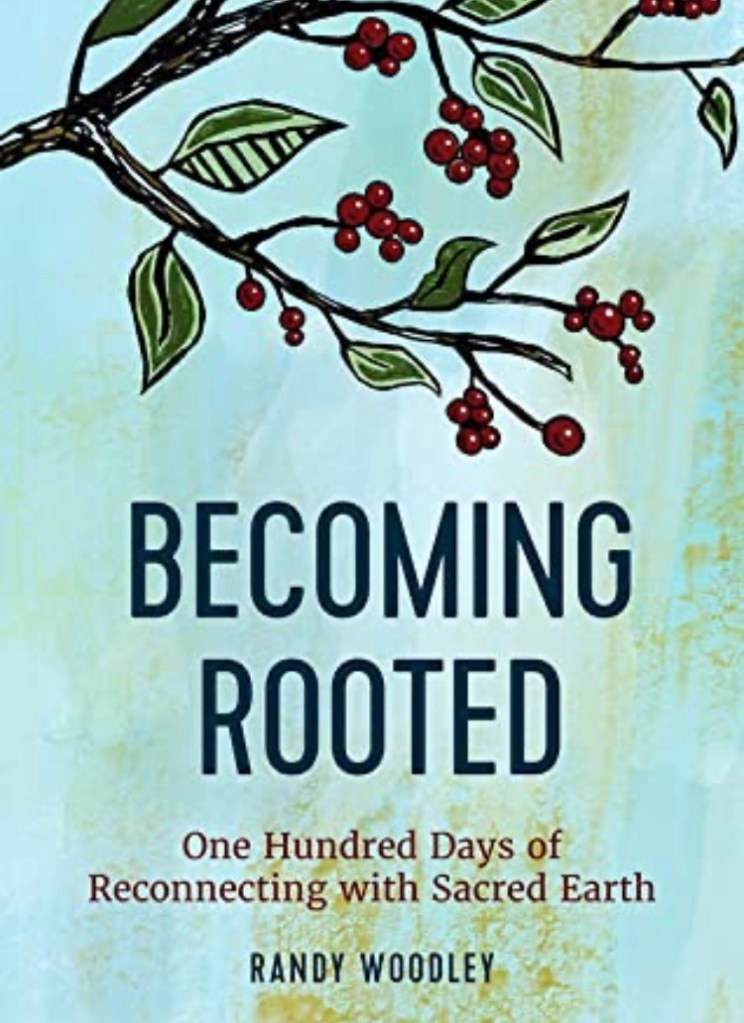
Book Review: ‘Becoming Rooted: One Hundred Days of Reconnecting with Sacred Earth’ by Randy Woodley

https://www.goodreads.com/book/show/58495625-becoming-rooted

Keetoowah Band Cherokee activity, author, and theologian Rev. Dr. Randy Woodley has crafted this brilliant 100 day devotional for people to connect with their faith more deeply by finding ways to become more rooted in the Sacred Land from which we came, the Land on which we live, and the Land to which we will return.

Each day starts with a short quote from an important figure to help calm our minds and prepare for the day’s reflection. Next comes a 2-3 page reflection on humanity, the land, and/or the living beings around us and how we can become more deeply connected with all creation. Finally, each day ends with a call to action, further reflection, or meditation. This enables folks to extend the learnings of the day into more rigorous/in-path/tangible ways throughout the day, as they are able. The book is divided into 10 thematic sections with 10 deviations each. It is a wonderful journey of reflection, discovery, and connection.

One of the most powerful outcomes of this book is how I was challenged to connect with my family’s cultural roots in deeper and more intentional ways through history, food, and cultural practices. Not only is this important for my own growth and learning as a vital part of my family, but also to challenge the pitfalls of white supremacy that force white folks to give up all cultural specificity for the privileges of supremacy and uniformness. As a result, this intentional work is vital for white folks to regain specificity, resist the uniformness of white supremacy, and learn how to be solidarity conspirators with our non-white siblings and all of creation.

This book is a powerful meditative tool for personal growth and reflection that leads to tangible communal outcomes and solidarity. Invest in this journey or reconnection with Sacred Earth today!