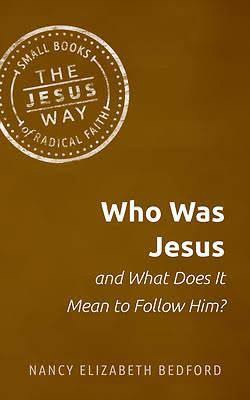
Review of ‘Who was Jesus and What does it Matter’ by Dr. Nancy Bedford

www.goodreads.com/review/show/4236110185

This short book from Dr. Nancy Bedford packs a vital theological punch. It poses the question ‘Who was Jesus’ and ‘What does it mean to follow him’ in an attempt to redirect the Church back toward the centrality of Christ, the gospel message, and what it means to be the Body of Christ. Without the centralization of Christ and what it means to tangibly follow Christ, the Church has lost its way. This text is a clarion call for our times with tangible steps for redirecting ourselves and our communities toward Christ.

Dr. Bedford provides 6 entry points into the two posed questions:

1. Who is Jesus of Nazareth and what does it mean to follow him?

2. Who is Jesus ‘the Incarnate One’ and what does it mean to follow him?

3. Who is Jesus as Prophet, Teacher, and Healer? And how to follow him?

4. Who is Jesus ‘the executed one?’ How do we follow him?

5. Who is Jesus resurrected and exalted? How do we follow him?

6. Who is Jesus in the Spirit, and how do we follow them?

This book is written to be accessible to all people and has discussion questions for each chapter. As a result, it is perfect for small groups! I highly recommend.

I’ll end this review with a succinct quote that I believe speaks to the concise clarity, beauty, and conviction of this text:

“If we say we follow Jesus, whenever it seems that the fruit of our discipleship does not lead to justice and peacemaking, it is time to reexamine our lives and those of our communities of faith. We can do so with the help of the Spirit by examining more closely the way Jesus lived (Matthew 7:15-20) and asking ourselves whether we are truly walking in his footsteps” (Dr. Nancy Bedford, ‘Who was Jesus and What Does it Mean to Follow Him,’ 74).

Amen!
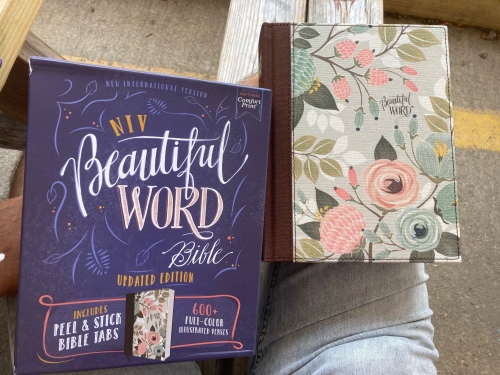
Review of ‘The NIV Beautiful Word Bible: Updated Version’

www.goodreads.com/book/show/45734929

First and foremost, I need to clear the air: this is NOT a gendered book. The only place where the editors hint at a particular presentation is when the editor’s note only mentions biblical figures Hannah and Esther. And to that, I say “come on editors, do better. Resist the idolatry of capitalism and gendered marketing, please. It harms all of us who cannot fit your false expectations of hyper masculinity and feminism.” We need to resist the consumer world that says a Bible designed to highlight the beauty of scripture does NOT mean that it should be primarily marketed to girls. Boys MUST learn to see the beauty of scripture, too. If you get this version for a girl, get it for a boy, too. The Bible is for all people, so let’s stop boxing ourselves in with gendered stereotypes. Thank you and I will now step off my soap box.

This Zondervan NIV 2011 updated translation, written in Zondervan NIV typeface, is a WONDERFUL version of the Bible that is highly engaging. First of all, it does what many versions cannot: it meets the needs of visual learners. The editors of this version worked with BibleGateway to find the most searched scriptures and balanced them with scriptures that are lesser known to present 600 scriptures in colorful artistic presentations through the entirety of the Bible! 9 different artists took charge of illuminating the 600 different scriptures. They also did a fantastic job of making the chosen scriptures memorizable so that folks can engage with their Scripture reading for memorization as well.

Each page of the Bible has a couple of inches on the edge with lines for note-taking. Every few pages has this space taken up with the artistic presentation of scripture. These illustrations are gorgeous and reflect the essence of each individual scripture.

The Bible also comes with sticker tabs for each book of the Bible, if you want to have the books of the Bible marked in this way. All this to say, this version of the Bible is meant to be engaged: written on, highlighted, and covered in stickers. Have at it! Mark it up and make it your own!

The Bible also comes with a sturdy box carrying case which is helpful for being mobile. It is also small enough to carry around with you! The cover itself is a gorgeous felt floral pattern with a woody brown felt binding. Visually appealing without being obnoxious.

The back of the Bible has a table for understanding biblical weights and measures in comparison with our modern weights and measures, an index of the 9 scripture artists and which scriptures illustrations they created, and 5 pages of lines for note-taking.

It has been a joy engaging with this visually stimulating and artistic version of the NIV translation Bible and I look forward to utilizing it and learning from it in the months/years to come!

Book Review of ‘The Plague’by Albert Camus

https://www.goodreads.com/review/show/761931279

What sounds like a good book to read during the resurgence of a global pandemic? How about a book detailing the ravages of the plague in the 1940’s?

But in all seriousness, this was an incredible book with insights and wisdoms terribly relevant today:


“When a war breaks out, people say: ‘It’s too stupid; it can’t last long.’ But though a war may well be ‘too stupid,’ that doesn’t prevent its lasting. Stupidity has a knack of getting its way; as we should see if we were not always so much wrapped up in ourselves. In this respect our townsfolk were like everybody else, wrapped up in themselves; in other words they were humanists: they disbelieved in pestilences. A pestilence isn’t a thing made to man’s measure; therefore we tell ourselves that pestilence is a mere bogy of the mind, a bad dream that will pass away. But it doesn’t always pass away and, from one bad dream to another, it is men who pass away, and the humanists first of all, because they haven’t taken their precautions. Our townsfolk were not more to blame than others; they forgot to be modest, that was all, and thought that everything still was possible for them; which presupposed that pestilences were impossible. They went on doing business, arranged for journeys, and formed views. How should they have given a thought to anything like plague, which rules out any future, cancels journeys, silences the exchange of views. They fancied them selves free, and no one will ever be free so long as there are pestilences” (Albert Camus 37).

Book Review of ‘The Interior Castle’ by St. Teresa of Avila

www.goodreads.com/book/show/162512

This book has been a balm, guide, challenge, and spiritual enrichment over the past month. I highly recommend it as a guide in time of devotion, prayer, and spiritual reflection!

Here are some of my favorite quotes:

“When we turn away from our small selves and toward God, both our understanding and our will become more sublime and more inclined to embrace all that is good. We would do ourselves great disservice if we never endeavored to rise above the mud of our personalized misery….If we are perpetually stuck in our own acre of tribulation, our stream will never flow free from the more of fear and faintheartedness” (47).

“Guard yourselves, my friends, against matters beyond your control” (50).

“Failing to deal with a problem out of fear of yielding to a negative temptation may be in itself yielding to a negative temptation” (52).

“Remember: all you have to do as you begin to cultivate the practice of prayer is to prepare yourself with sincere effort and intent to bring your will into harmony with the will of God” (61).

“Perfection isn’t about consolation, it’s about loving. We are rewarded by doing whatever we do with righteousness and love” (81).

“Remember: if you want to make progress in the path path and ascend to the places you have longed for, the important thing is not to think much but to love much, and so to do whatever best awakens your love” (91).

“I think that His majesty wishes we would do whatever it takes to understand ourselves. We need to quit blaming the soul for problems caused by a weak imagination, human nature, and the spirit of evil” (95).

“On the spiritual path, the Beloved asks only two things of us: that we love him and that we love each other…. if we do these perfectly, we are doing his well and so we will be united with him” (140).

“No matter how spiritual a soul may be, it’s not wise to reject corporeal forms. Meditating on the holiness of humanness is not unholy” (221).

“The more we understand about God‘s communion with creatures, the more we will praise his greatness. We should cultivate reverence for souls in whom our Beloved seems to take such delight. Each of us has a soul, but we forget to value it. We don’t remember that we are creatures made in the image of God. We don’t understand the great secrets hidden inside of us” (259-260).

“Remember: good works are a sign of God‘s blessing” (288).

“Even if our deeds are small, they will be made great through the greatness of our love for God” (295).

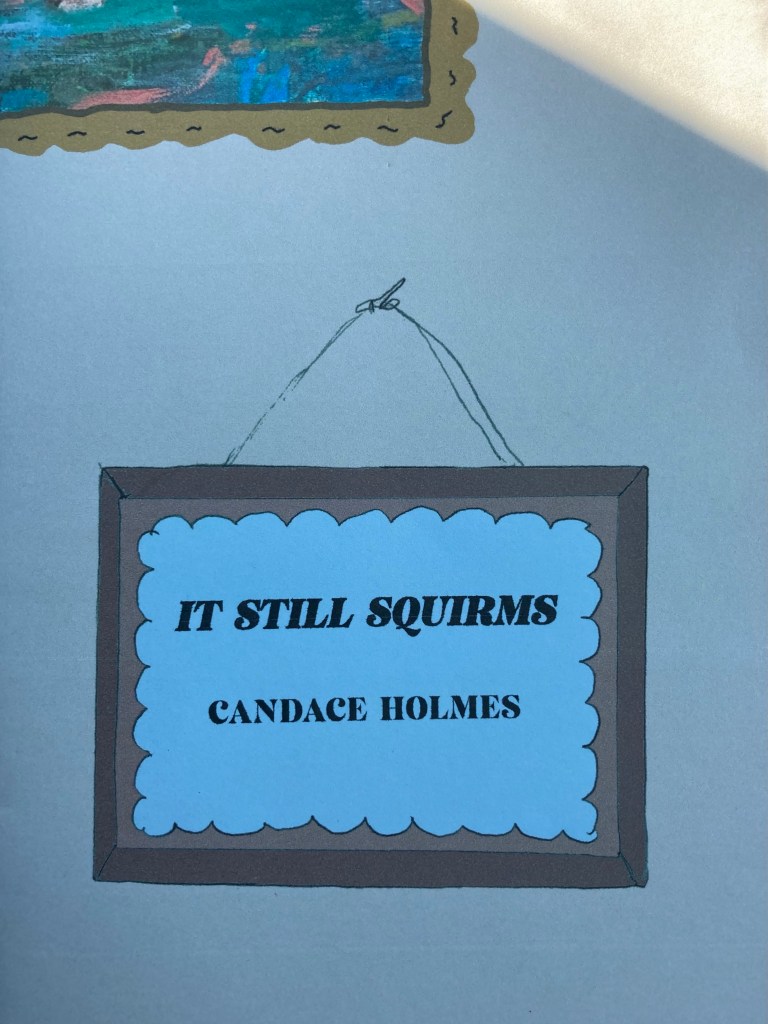
‘It Still Squirms’ by Candace Holmes

https://www.goodreads.com/book/show/58676994

This breakout collection of poems is a must read! Candace utilizes the medium of poetry to explore the ways in which we attempt to process the world/experiences around us (and often fail).

The poems are presented with material lists connected with the content, creating an experience akin to meandering a museum of art pieces. This is a truly novel presentation method that impacts the overall reading of each poem, if you choose to engage.

Check out this introspective, witty, and relevant collection of poems today!

It Still Squirms, by Candace Holmes

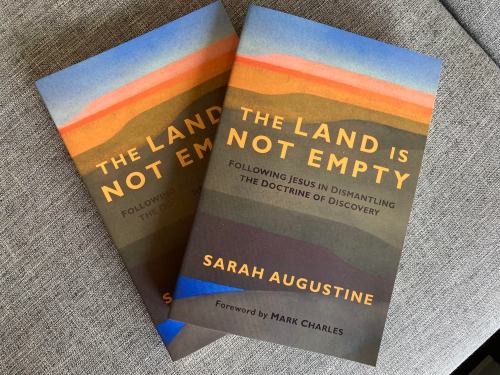
Study Guide for ‘The Land is Not Empty: Following Jesus in Dismantling the Doctrine of Discovery’ by Sarah Augustine

The Study Guide I wrote for Sarah Augustine’s incredible book, ‘The Land is Not Empty: Following Jesus in Dismantling the Doctrine of Discovery,’ is officially available online: https://heraldpress.com/wp-content/uploads/2021/06/The-Land-Is-Not-Empty-study-guide.pdf

Purchase a copy of Augustine’s book today: https://heraldpress.com/books/the-land-is-not-empty/

Book Review: ‘The Black Trans Prayer Book,’ Co-Edited by J Mase III & Lady Dane Figueroa Edidi

The Black Trans Prayer Book by J Mase III

My rating: 5 of 5 stars


In a world where the enforced norm for life and existence marginalizes all identities that don’t ‘fit,’ identify-affirming practices are a form of life-giving resistance. As a result, ‘The Black Trans Prayer Book’ is a site of life creation and salvific resistance with God by offering interfaith prayers, poems, visual art, and a variety of other spiritual practices, created by Black Trans, Intersex, and Non-Binary authors, that demonstrate the belovedness, sacredness, and blessedness of all people to God, but specifically the people most marginalized by the powers and principalities of this world.

This text is sacred and vital space necessary for the holistic self-care and divine strength necessary for the Spirit-driven transformation work of dismantling white supremacy, racism, homophobia, transphobia, and all of the other violent sins that harm and exclude in our society, toward the evermore creation/embodiment of God’s Kin(g)dom here on our precious and physical earth. Amen


View all my reviews

Book Review: ‘A History of My Brief Body’ by Billy-Ray Belcourt

www.goodreads.com/book/show/54620517

“What determines our lives as NDNs and/or queers are pain and trauma, love and hope. Death looms at all scales, individual to planetary. But there is also an ecology of creativity, one indivisible from our futurity. In the face of an antagonistic relation to the past, let us start anew in heaven of the world in the image of our radical art” (Billy-Ray Belcourt, ‘A History of My Brief Body,’ 128).

Book Review for ‘Climate Church, Climate World: How People of Faith Must Work for Change’ by Jim Antal

Climate Church, Climate World: How People of Faith Must Work for Change by Jim Antal

My rating: 5 of 5 stars


‘Climate Church, Climate World: How People of Faith Must Work for Change’ by Jim Antal is one of the most concise, coherent, and personal explanations of the Christian imperative for the Church to be at the forefront of addressing Climate Change that I have ever read. Antal expertly weaves scripture and theological doctrines with explanations of scientific data mixed and personal experiences/human stories to demonstrate of how Climate justice is an intersectional issue that Christians cannot ignore.

He starts out by laying down the facts of the climate crisis in which we live and all of its intersectional justice issues it causes/affects in chapter one. In chapter two, he demonstrates how God is the guide and framework from which we can address these intersectional issues of the climate crisis. He then explains how climate change activism must become a central vocation of the church today in chapter three. He then explains how a church can analyze itself for true climate justice work through different fruits, or marks, in chapter four. Chapter five explains how addressing the climate crisis is actually discipleship/training issue. He follows this up with an explanation of how Christian worship is a central pathway to manifesting discipleship and vocation through climate justice in chapter six. This puts an imperative upon clergy to be at the forefront of this training and justice work in the Church. As a result, Antal provides tangible advice and actions that clergy can take toward prophetic climate justice preaching in chapter seven. Chapter eight than explains how the Church can work toward communal action and communal salvation together through climate justice action, often in the form of civil disobedience as spiritual practice. Chapter nine explains how optimism, while helpful, is not ‘hope.’ In the face of the dire climate crisis facing us, positive thinking is not enough. We must have faith and trust in the HOPE that God will transform our actions toward climate justice into tangible miracles and change. And we must do this by having love, gratitude, and care toward the Earth through the worship and recognition of our CREATOR God. Finally, Antal closes out the book with an epilogue and appendix that provide first hand insights and resources for faith leaders (clergy and lay leaders) to use in moving their communities toward climate justice communities.

In considering how gratitude and love must ground our hope driven work rather than silence and fear, this quote was my favorite:
“ when considering civil disobedience and the other forms of witness, people have shared with me that love is their most powerful motivation-Love of God; mother nature; love a beauty; love of their children; love of creatures and plants and all their diversity; love the impossible way in which this planet provides all living things with everything we need to flourish. What I have seen time and time again is that when a person allows herself to love creation in these and other ways, and when a person also allows herself to face the extent to which humanity has compromised, extinguished, and threatened all that she loves, the courage emerges to respond to the call to bear witness. Gratitude is another powerful motivating force among those who bear witness-gratitude for having been given life; gratitude for God‘s creation and all the ways it has nourished one’s life; gratitude for the support that friends and loved ones are provided; gratitude for this particular moment, as well as the gift of time itself; gratitude for the dreams and aspirations that mysteriously arise from within…. Fear that what we love will be destroyed is a powerful catalyst for action. That fear is amplified if we learn that far off consequences will soon be imminent. But a person needs more than fear to stay engaged and make long-term changes and enduring commitments. If you are can be an affective catalyst. But the most powerful motivators and sustainers of change are love and gratitude” (144-145).

Be blessed by these words and act. Amen.


View all my reviews

Book Review of ‘On Tyranny: Twenty Lessons from the Twentieth Century’ by Timothy Snyder

On Tyranny: Twenty Lessons from the Twentieth Century by Timothy Snyder

My rating: 5 of 5 stars


Even though Trump lost the 2020 election, we have much work to do in restoring/expanding electoral democracy into a truly accessible and representative system. This book provides practical and essential signposts and steps to resist tyranny/authoritarianism and evermore live-into our representative democracy.

‘On Tyranny: Twenty Lessons from the Twentieth Century’ by Timothy Snyder is a MUST read that is concise, direct, and pocket sized!

“Any election can be the last, or at least the last in the lifetime of the person casting the vote” (Snyder 29).

“We believe that we have checks and balances, but have rarely faced a situation like the present: when the less popular of the two parties controls every lever of power at the federal level, as well as the majority of state houses. The party that exercises such control proposes few policies that are popular with the society at large, and several that are generally unpopular – and thus must either fear democracy or weaken it” (Snyder 30).

“You submit to tyranny when you renounce the difference between what you want to hear and what is actually the case….As observers of totalitarianism…noticed, truth dies in four modes. The first mode is the open hostility to verifiable reality, which takes the form of presenting inventions and lies as if they were facts. The president does this at a high rate and at a fast pace. One attempt during the 2016 campaign to track his utterances found that 78% of his factual claims were false. This proportion is so high that it makes the correct assertions seem like unintended oversights on the path toward total fiction. Demeaning the world as it is begins the creation of a fictional counter world” (Snyder 66).

“Since in the age of the Internet we are all publishers, each of us bears some private responsibility for the public’s sense of truth. If we are serious about seeking the facts, we can each make a small revolution in the way the Internet works. If you are verifying information for yourself, you will not send on fake news to others. If you choose to follow reporters whom you have reason to trust, you can also transmit what they have learned to others. If you retweet only the work of humans who have followed journalistic protocols, you are less likely to debase your brain interacting with bots and trolls. We do not see the minds that we hurt when we publish falsehoods, but that does not mean we do not harm. Think of driving a car. We may not see the other driver, but we know not to run into their car. We know that the damage will be mutual. We protect the other person without seeing him, dozens of times every day. Likewise, although we may not see the other person in front of his or her computer, we have our share of responsibility for what is on the screen. If we can avoid doing violence to the minds of unseen others on the Internet, others will learn to do the same. And then perhaps our Internet traffic will cease to look like one great, bloody accident” (Snyder 79-80).

“When the American president speaks of fighting terrorism alongside Russia, what he is proposing to the American people is terror management: the exploitation of real, dubious, and simulated terror attacks to bring down democracy. The Russian recap of the first telephone call between the president and Vladimir Putin is telling: the two men “shared the opinion that it is necessary to join forces against the common enemy number one: international terrorism and extremism” (Snyder 109-110).

“A nationalist will say that “it can’t happen here,” which is the first step toward disaster. A patriot says that it could happen here, but that we will stop it” (Snyder 114).

“If young people do not begin to make history, politicians of eternity and inevitability will destroy it. And to make history, young Americans will have to know some. This is not the end, but a beginning” (Snyder 126).


View all my reviews