I Voted! You Should, Too!

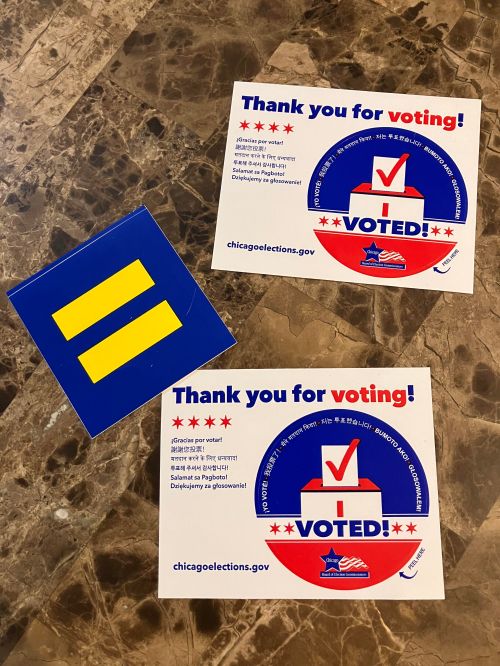
I Voted!

I am proud to have voted for the Vice President Kamala Harris and Governor Tim Walz presidential ticket. While I do have policy and ethical issues with some of the tickets’ policies, there is more potential for positive change through advocacy and lobbying within the Harris/Walz ticket than with the Trump/Vance ticket.

I support the Harris/Walz ticket for three reasons. First, I believe that the policy and personal integrity of the Harris/Walz ticket better reflects the Christian faith values that I hold, especially when you take seriously Christ’s gospel ministry proclamation in Luke 4:14-21, as well as the fruit of the Spirit in Galatians 5:22-23. I think that character matters and that the words people say matters. I respect how Harris and Walz present themselves and the ways in which they interact with others.

Second, this is a personal election. As Connor and I imagine having a family, a Trump presidency would put that into question. I take seriously the words of Trump, Clarence Thomas, Project 2025, and others when they suggest the overturning of same-sex marriage and the outlawing of same-sex couple adoption. Even if such restrictive proposals were sequestered within only certain states and we remained safe in Illinois, traveling into states that would not recognize our marriage would be dangerous. For example, if we had a car accident on our drive to visit family in other states, the hospitals in another state could keep Connor, me, and our kids apart. This is not a future that I want for any family, let alone my own, thus I eagerly support Harris/Walz who advocate for all families, including LGBTQIA+ families.

Third, Harris and Walz represent the diversity of America in a way that Trump/Vance do not. Harris and Walz exude integrity and genuineness in their relationships with their families, friends, and constituents. Furthermore, I cannot wait to vote for a fellow Nebraskan! Go big red!

For these reasons, I cast my vote for the Harris/Walz presidential ticket. I am happy to chat with folks who are unsure OR folks who disagree with me. I just ask that you please DM, text, or call me, not write in the comments. This post is a personal testimony, not an invitation for battles in the comment section.

And no matter what, please exercise your civic duty and make your voice heard: VOTE!

I will be praying for all Americans, for all candidates, for peace across the globe, and for all God’s beloved creation.

Thank you and God bless!

Christians & Politics: A Prayer of Lament and a Prayer of Hope

Weave

Christians on political “sides” subscribe to a binary and oppositional understanding of our faith and political engagement that causes separation, harm, and idolatry.

Republicans, especially in the new Trump era, have increasingly synthesized salvific hope and politics toward a Divine King/Strong-Man Nationalism theology. This is problematic since Christ brought salvation in a way antithetical to cultural/political power, control, and exclusion. Instead, he offered preferential and tangible hope for the oppressed/marginalized. He frequently challenged, and even condemned, the power players perpetuating inequality. Ascribing divine privilege to a power-player, like Trump, toward the ends of Christian nationalist control, is idolatry.

On the flipside, Democrats often want to silence faith-led conviction in the polis, falsely believing that a true separation of faith/politics, public/private, secular/sacred is possible. This leads to an idolatry of law, legal systems, and political figures as the sites of salvation and hope.

Christians must be constantly self-reflective and challenge ourselves away from the allure of false-hopes within these camps. Our salvation is in Christ. The gospel message leads us to discern and question all powers that exist if their outcomes are not equivalent to the criteria of Christ’s ministry pronouncement of Luke 4:14-30, or the fruit of the Spirit in Galatians 5:22-23.

Neither party does this. There is no easy-answer to the challenge of discerning and voting with our conscience based on these faith-based criteria. Consequently, no party should have our faith and devotion. No PAC or politically activated denominational or faith-based political platform should have our faith and devotion. No nation or national symbol should have our faith and devotion. No power, system, or institution of humankind should have our faith and devotion. Only the gospel message of Jesus Christ, which commands us to love God and our neighbor as ourselves (Mark 12:30-31), and the subsequent discernment and action of the Holy Spirit in our individual and communal lives, should have our faith and devotion. All else is idolatry. Idolatry that leads to hate and violence in our hearts (and sometimes actions) toward others not like us, or those who hold different values. God clearly warns against this in Matthew 5:43-48.

As the divisive and violent party-driven rhetoric amps up in the next few months, I pray that I, and all of us who follow Christ, remember this counter-cultural message. I pray that we strive to be presences of mediation and love during these volatile times. May the gospel message that we proclaim and live-out be good news for all, not for some. May our words, actions, and lives point to God’s peaceable kingdom on Earth now, as it is in heaven.

We CAN do all things through Christ who strengthens us.

Amen.

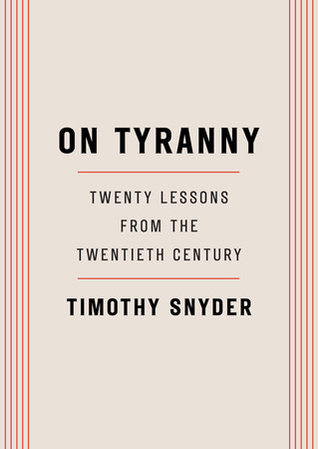
Book Review of ‘On Tyranny: Twenty Lessons from the Twentieth Century’ by Timothy Snyder

On Tyranny: Twenty Lessons from the Twentieth Century by Timothy Snyder

My rating: 5 of 5 stars


Even though Trump lost the 2020 election, we have much work to do in restoring/expanding electoral democracy into a truly accessible and representative system. This book provides practical and essential signposts and steps to resist tyranny/authoritarianism and evermore live-into our representative democracy.

‘On Tyranny: Twenty Lessons from the Twentieth Century’ by Timothy Snyder is a MUST read that is concise, direct, and pocket sized!

“Any election can be the last, or at least the last in the lifetime of the person casting the vote” (Snyder 29).

“We believe that we have checks and balances, but have rarely faced a situation like the present: when the less popular of the two parties controls every lever of power at the federal level, as well as the majority of state houses. The party that exercises such control proposes few policies that are popular with the society at large, and several that are generally unpopular – and thus must either fear democracy or weaken it” (Snyder 30).

“You submit to tyranny when you renounce the difference between what you want to hear and what is actually the case….As observers of totalitarianism…noticed, truth dies in four modes. The first mode is the open hostility to verifiable reality, which takes the form of presenting inventions and lies as if they were facts. The president does this at a high rate and at a fast pace. One attempt during the 2016 campaign to track his utterances found that 78% of his factual claims were false. This proportion is so high that it makes the correct assertions seem like unintended oversights on the path toward total fiction. Demeaning the world as it is begins the creation of a fictional counter world” (Snyder 66).

“Since in the age of the Internet we are all publishers, each of us bears some private responsibility for the public’s sense of truth. If we are serious about seeking the facts, we can each make a small revolution in the way the Internet works. If you are verifying information for yourself, you will not send on fake news to others. If you choose to follow reporters whom you have reason to trust, you can also transmit what they have learned to others. If you retweet only the work of humans who have followed journalistic protocols, you are less likely to debase your brain interacting with bots and trolls. We do not see the minds that we hurt when we publish falsehoods, but that does not mean we do not harm. Think of driving a car. We may not see the other driver, but we know not to run into their car. We know that the damage will be mutual. We protect the other person without seeing him, dozens of times every day. Likewise, although we may not see the other person in front of his or her computer, we have our share of responsibility for what is on the screen. If we can avoid doing violence to the minds of unseen others on the Internet, others will learn to do the same. And then perhaps our Internet traffic will cease to look like one great, bloody accident” (Snyder 79-80).

“When the American president speaks of fighting terrorism alongside Russia, what he is proposing to the American people is terror management: the exploitation of real, dubious, and simulated terror attacks to bring down democracy. The Russian recap of the first telephone call between the president and Vladimir Putin is telling: the two men “shared the opinion that it is necessary to join forces against the common enemy number one: international terrorism and extremism” (Snyder 109-110).

“A nationalist will say that “it can’t happen here,” which is the first step toward disaster. A patriot says that it could happen here, but that we will stop it” (Snyder 114).

“If young people do not begin to make history, politicians of eternity and inevitability will destroy it. And to make history, young Americans will have to know some. This is not the end, but a beginning” (Snyder 126).


View all my reviews