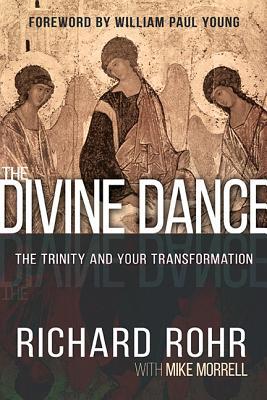
My Goodreads review of The Divine Dance: The Trinity and Your Transformation by Richard Rohr with Mike Morrell; My rating: 5 of 5 stars
I started this book not knowing what to expect and was thrilled to find myself deeply transformed by it.
For me, this text accomplishes three important goals:
1. It provides a contemporary, contextual, and relevant depiction of trinitarian theology and why the Holy Trinity is so important.
2. It calls out the violence of retribution theology that undergirds atonement theology. Furthermore, Rohr and Morrell provide a clear alternative to atonement theology through trinitarian theology.
3. It conveys abstract and complex theological concepts in palatable and accessible language and metaphors.
This book is split into 4 parts. First, the Introduction. This section includes a wonderful forward from William Paul Young and a helpful ‘Trinity 101’ to set the stage for the rest of the book. Part I focuses on the need for a paradigm shift in how we understand the centrality of the Holy Trinity in our personal and communal spiritual lives and ecclesial structures. To demonstrate this, Rohr does a brilliant historical trajectory of the Christian understanding of trinitarian theology. Part II makes a cause for the contemporary and contextual necessity for trinitarian theology primacy. Our embarrassment of the complexity and mystery of trinitarian theology is rooted in an idolatry of empirical data and a distant/detached God that only embracing the divine dance of the Holy Trinity can topple. Part III spends some time focusing on the vital importance of the Holy Spirit within the Holy Trinity AND her central role in centralizing trinitarian theology in our everyday lives/relationships. Rohr and Morrell then provide 7 spiritual practices to try implementing much of what we learned throughout the text.
This book taught me, challenged me, convicted me, and brought me life-giving joy. I would highly recommend it to any and all Christians, and folks who are curious about inter-religious dialogue.
To end my review, here are a few of my favorite quotes:
“All is whole and holy in the very seeing, because you are standing inside the One Flow of Love without the negative pushback of doubting. This is all that there really is. Call it Consciousness, call it God, call it Love; this is the Ground of all Being out of which all things-and especially all good things-come” (86-7).
“Stridently taking sides in a binary system has nothing to do with truth. The gospel itself is neither liberal nor conservative but severely critiques both sides of this false choice. The true good news of Jesus will never fill stadiums, because dualistic masses can never collectively embrace an enlightened ‘Third Way,’ which, contemplatively speaking, always feels a bit like nothing, because in this position you are indeed like Jesus-you have ‘no place to lay you head’ (100).
“Godly knowing is a humble and non-grasping kind of knowledge; it becomes a beautiful process of communion instead of ammunition and power over. It is basically reverence! Knowing without loving is frankly dangerous for the soul and for society. You’ll critique most everything you encounter and even have the hubris to call this mode of reflexive cynicism ‘thinking’ (whereas it’s really your ego’s narcissistic reaction to the moment). You’ll position things too quickly as inferior or superior, ‘with me’ or ‘against me,’ and most of the time you’ll be wrong” (103).
“The Spirit’s work, if we observe, is always to create and then to fully allow otherness; creating many forms and endless diversity seems to be the plan. Creating differences, and then preserving them in being” (113).
“I think penal substitution is a very risky theory, primarily because of what it implies about the Father’s lack of freedom to love or to forgive his own creation….Humans change in the process of love-mirroring, and not by paying any price or debt….The cross is the standing icon and image of God, showing us that God knows what it’s like to be rejected; God is in solidarity with us in the experience of abandonment; God is not watching the suffering from a safe distance. Somehow, believe it or not, God is in the suffering with us. God is is not only stranger than we thought, but stranger than we’re capable of thinking! But we tried to pull salvation into some kind of quid pro quo logic and justice theory-and retributive justice at that! God’s justice, revealed in the prophets, is always restorative justice, but this takes a transformed consciousness to understand….The quid pro quo, retributive mind has to break down in order to truly move forward with God. This is the unique job description of grace and undeserved mercy” (132).
“The biblical text mirrors both the growth and the resistance of the soul….the text moves inexorably toward inclusivity, mercy, unconditional love, and forgiveness. I call it the ‘Jesus hermeneutic.’ Just interpret Scripture the way that Jesus did! He ignores, denies, or openly opposes his own Scriptures whenever they are imperialistic, punitive, exclusionary, or tribal” (137).
“Jesus became incarnate to reveal the image of the invisible God. The personal Incarnation is the logical conclusion of God’s love affair with creation….God in Jesus became what God loves-everything human….God had to become human once the love affair began, because-strictly speaking-love implies some level of likeness or even equality. The Incarnation was an inevitable conclusion, not an accident or an anomaly. It shouldn’t have been a complete surprise to us. God was destined and determined, I believe, to become a human being, but it’s still a big deal when the impossible gap is overcome from God’s side and by God’s choice, even if it was from the beginning….You see, Incarnation is, rightly appreciated, is already redemption-Jesus doesn’t need to die on the cross to convince us that God loves us, although I surely admit that the dramatic imagery has convinced and convicted many a believer. The cross corrected our serious nearsightedness in relation to the Father, buying the human soul a good pair of glasses to clearly see the Father’s love. The mystery of Incarnation is already revealing God’s total embrace” (174-5).
“If you believe that the Son’s task is merely to solve some cosmic problem the Father has with humanity, that the Son’s job is to do that, then once the problem is solved, there’s apparently no need for the concrete imitation of Jesus or his history-changing teachings. Yes, we continue to thank him for solving this problem, but we’ve lost the basis for an ongoing communion, a constant love affair, not to mention the wariness we now have about the Father and the lack of an active need for a dynamic Holy Spirit. The idea of God as Trinity largely fell apart once we pulled Jesus out of the One Flow and projected our problem onto God. We needed convincing, not God” (176).
“Any staying in relationship, any insistence on connection, is always the work of the Spirit, who warms, softens, mends, and renews all the broken, cold places in and between things. The Holy Spirit is always ‘the third force’ happening between any two dynamics. Invisible but powerful, willing to be anonymous, she does not care who gets the credit for the wind from nowhere, the living water that we take for granted, or the bush that always burns and is never consumed” (187).
“Your job is simply to exemplify heaven now. God will take it from there. Here is the remedy when you find it hard to exemplify heaven now: Let love happen….Love is just like prayer; it is not so much an action that we do but a reality that we are. We don’t decide to ‘be loving….’ The love in you-which is the Spirit in you-always somehow says yes. Love is not something you do; love is someone you are. It is your True Self” (192-3).
I hope this quotes bless you as they have blessed me.
View all my reviews
I started this book thinking that I would enjoy it and was surprised to find myself deeply transformed by it.
For me, this text accomplishes three important goals:
- It provides a contemporary, contextual, and relevant depiction of trinitarian theology and why the Holy Trinity is so important.
- It calls out the violence of retribution theology that undergirds atonement theology. Furthermore, Rohr and Morrell provide a clear alternative to atonement theology through trinitarian theology.
- It conveys abstract and complex theological concepts in palatable and accessible language and metaphors.
This book is split into 4 parts. First, the Introduction. This section includes a wonderful forward from William Paul Young and a helpful ‘Trinity 101’ to set the stage for the rest of the book. Part I focuses on the need for a paradigm shift in how we understand the centrality of the Holy Trinity in our personal and communal spiritual lives and ecclesial structures. To demonstrate this, Rohr does a brilliant historical trajectory of the Christian understanding of trinitarian theology. Part II makes a cause for the contemporary and contextual necessity for trinitarian theology primacy. Our embarrassment of the complexity and mystery of trinitarian theology is rooted in an idolatry of empirical data and a distant/detached God that only embracing the divine dance of the Holy Trinity can topple. Part III spends some time focusing on the vital importance of the Holy Spirit within the Holy Trinity AND her central role in centralizing trinitarian theology in our everyday lives/relationships. Rohr and Morrell then provide 7 spiritual practices to try implementing much of what we learned throughout the text.
This book taught me, challenged me, convicted me, and brought me life-giving joy. I would highly recommend it to any and all Christians, and folks who are curious about inter-religious dialogue.
To end my review, here are a few of my favorite quotes:
“All is whole and holy in the very seeing, because you are standing inside the One Flow of Love without the negative pushback of doubting. This is all that there really is. Call it Consciousness, call it God, call it Love; this is the Ground of all Being out of which all things-and especially all good things-come” (86-7).
“Stridently taking sides in a binary system has nothing to do with truth. The gospel itself is neither liberal nor conservative but severely critiques both sides of this false choice. The true good news of Jesus will never fill stadiums, because dualistic masses can never collectively embrace an enlightened ‘Third Way,’ which, contemplatively speaking, always feels a bit like nothing, because in this position you are indeed like Jesus-you have ‘no place to lay you head’ (100).
“Godly knowing is a humble and non-grasping kind of knowledge; it becomes a beautiful process of communion instead of ammunition and power over. It is basically reverence! Knowing without loving is frankly dangerous for the soul and for society. You’ll critique most everything you encounter and even have the hubris to call this mode of reflexive cynicism ‘thinking’ (whereas it’s really your ego’s narcissistic reaction to the moment). You’ll position things too quickly as inferior or superior, ‘with me’ or ‘against me,’ and most of the time you’ll be wrong” (103).
“The Spirit’s work, if we observe, is always to create and then to fully allow otherness; creating many forms and endless diversity seems to be the plan. Creating differences, and then preserving them in being” (113).
“I think penal substitution is a very risky theory, primarily because of what it implies about the Father’s lack of freedom to love or to forgive his own creation….Humans change in the process of love-mirroring, and not by paying any price or debt….The cross is the standing icon and image of God, showing us that God knows what it’s like to be rejected; God is in solidarity with us in the experience of abandonment; God is not watching the suffering from a safe distance. Somehow, believe it or not, God is in the suffering with us. God is is not only stranger than we thought, but stranger than we’re capable of thinking! But we tried to pull salvation into some kind of quid pro quo logic and justice theory-and retributive justice at that! God’s justice, revealed in the prophets, is always restorative justice, but this takes a transformed consciousness to understand….The quid pro quo, retributive mind has to break down in order to truly move forward with God. This is the unique job description of grace and undeserved mercy” (132).
“The biblical text mirrors both the growth and the resistance of the soul….the text moves inexorably toward inclusivity, mercy, unconditional love, and forgiveness. I call it the ‘Jesus hermeneutic.’ Just interpret Scripture the way that Jesus did! He ignores, denies, or openly opposes his own Scriptures whenever they are imperialistic, punitive, exclusionary, or tribal” (137).
“Jesus became incarnate to reveal the image of the invisible God. The personal Incarnation is the logical conclusion of God’s love affair with creation….God in Jesus became what God loves-everything human….God had to become human once the love affair began, because-strictly speaking-love implies some level of likeness or even equality. The Incarnation was an inevitable conclusion, not an accident or an anomaly. It shouldn’t have been a complete surprise to us. God was destined and determined, I believe, to become a human being, but it’s still a big deal when the impossible gap is overcome from God’s side and by God’s choice, even if it was from the beginning….You see, Incarnation is, rightly appreciated, is already redemption-Jesus doesn’t need to die on the cross to convince us that God loves us, although I surely admit that the dramatic imagery has convinced and convicted many a believer. The cross corrected our serious nearsightedness in relation to the Father, buying the human soul a good pair of glasses to clearly see the Father’s love. The mystery of Incarnation is already revealing God’s total embrace” (174-5).
“If you believe that the Son’s task is merely to solve some cosmic problem the Father has with humanity, that the Son’s job is to do that, then once the problem is solved, there’s apparently no need for the concrete imitation of Jesus or his history-changing teachings. Yes, we continue to thank him for solving this problem, but we’ve lost the basis for an ongoing communion, a constant love affair, not to mention the wariness we now have about the Father and the lack of an active need for a dynamic Holy Spirit. The idea of God as Trinity largely fell apart once we pulled Jesus out of the One Flow and projected our problem onto God. We needed convincing, not God” (176).
“Any staying in relationship, any insistence on connection, is always the work of the Spirit, who warms, softens, mends, and renews all the broken, cold places in and between things. The Holy Spirit is always ‘the third force’ happening between any two dynamics. Invisible but powerful, willing to be anonymous, she does not care who gets the credit for the wind from nowhere, the living water that we take for granted, or the bush that always burns and is never consumed” (187).
“Your job is simply to exemplify heaven now. God will take it from there. Here is the remedy when you find it hard to exemplify heaven now: Let love happen….Love is just like prayer; it is not so much an action that we do but a reality that we are. We don’t decide to ‘be loving….’ The love in you-which is the Spirit in you-always somehow says yes. Love is not something you do; love is someone you are. It is your True Self” (192-3).
I hope this quotes bless you as they have blessed me.





























 Deacon Grant