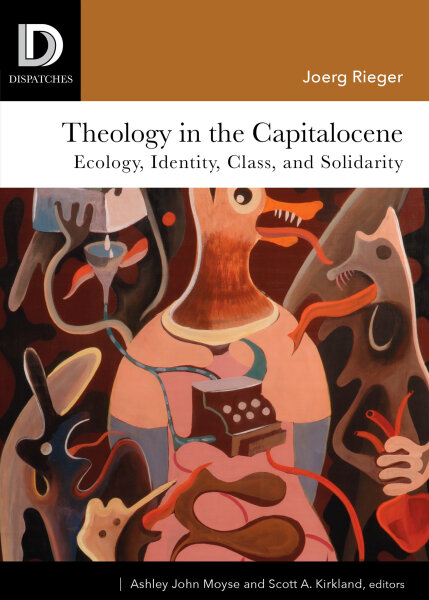
Check out my review of Joerg Rieger’s book, Theology in the Capitalocene: Ecology, Identity, Class, and Solidarity, in the latest issue of Religious Studies Review, Volume 50, Issue 1: https://onlinelibrary.wiley.com/doi/10.1111/rsr.16962
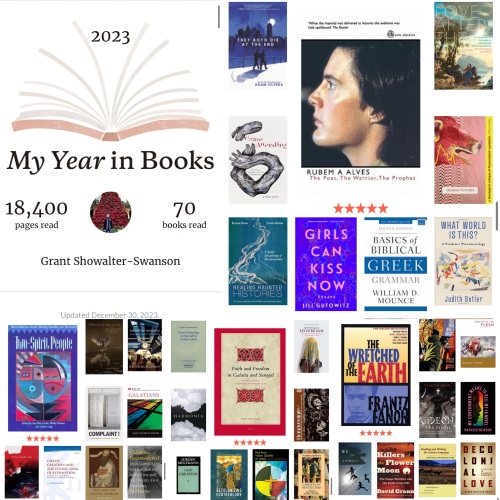
1. When the Light of the World Was Subdued, Our Songs Came Through: A Norton Anthology of Native Nations Poetry, edited by Joy Harjo, with LeAnne Howe and Jennifer Elise Foerster

2. Poet, the Warrior, the Prophet, by Rubem Alves

3. Decolonial Christianities: Latinx and Latin American Perspectives, edited by Raimundo Barreto and Roberto Sirvent

4. Reading and Writing the Lakota Language, by Albert White Hat Sr.

5. Healing Haunted Histories: A Settler Discipleship of Decolonization, by Elaine Enns and Ched Myers

6. Galatians: A Theological Commentary on the Bible, by Nancy Elizabeth Bedford

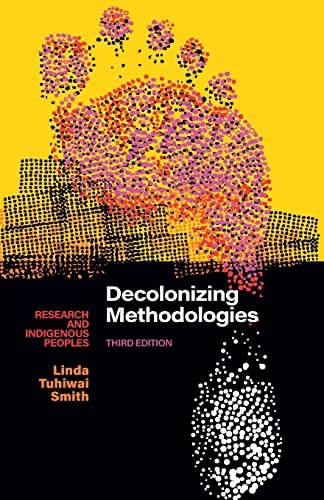
7. Decolonizing Methodologies: Research and Indigenous Peoples, by Linda Tuhiwai Smith

8. Complaint!, by Sara Ahmed

9. Faith and Freedom in Galatia and Senegal: The Apostle Paul, Colonists and Sending Gods, by Aliou Cissé Niang

10. Trading Futures: A Theological Critique of Financialized Capitalism, by Filipe Maia

I recently had the opportunity to read and write the study guide for Sarah Augustine and Sheri Hostetler’s new book, So We and Our Children May Live: Following Jesus in Confronting the Climate Crisis. You can find the study guide on this website under the “S” titles: https://heraldpress.com/study-guides/. Reading this text was both a challenge and an inspiration. As Patty Krawec states in the forward, “In addition to laying out the stark realities of our circumstances, Sarah and Sheri have also laid out strategies for that confrontation. Things that we can and should do, things we can and should demand” (11). Consequently, this book is a prophetic naming of the disastrous realities of the global climate crisis, while also being a practical guide for responding to this present nightmare.
Augustine and Hostetler approach this collaborative work together, bringing their full identities to bear as North Americans: Augustine as a Pueblo (Tewa) descendant and Mennonite; Hostetler as a descendant of Swiss Amish Mennonite farmers. Through this collaborative dialogic, Augustine and Hostetler name the process of confronting the climate crisis as the work of decolonization, solidarity, and survival. They strive to accomplish this work by structuring the book into three parts.
The first part contrasts the lived experiences of “Reality” versus the web of lies spun by the global extractive logic of “reality.” As Christians, Augustine and Hostetler connect “Reality” with God’s kingdom vision for the world: past, present, and future. In the second part of the book, Augustine and Hostetler interrogate popularized approaches to climate change through the “Green Growth” movement and reveal the deadly limitations of these initiatives. Finally, in the third part, Augustine and Hostetler propose an alternate vision of ecological justice and right relationship by providing tangible steps toward co-creating a decolonized future.
Augustine and Hostetler provide a compelling and practical case that both names Reality and offers practical steps toward co-creating a just future for all people and creation. As Augustine and Hostetler reveal, the stakes are great: “We can imagine and choose a life-sustaining, just civilization, or we can continue business as usual. Life and death. What’s good and what’s wrong. That is our choice” (26). My hope and prayer is that this book, and the discussions sparked by it through conversations, reading groups, and study-guide engagement, can lead us toward action in choosing life. Amen.
Beguiled by Beauty: Cultivating a Life of Contemplation and Compassion by Wendy Farley is a practical exploration of the practice of contemplation and attentiveness to beauty. Farley makes this connection between contemplation and beauty by first emphasizing that “the core practice of a contemplative way of life is radical compassion….A contemplative way of life is motivated by a devotion to the welfare of others” (7). While contemplation is primarily practiced through interior work and discipline, Farley notes that such interior work is oriented toward relationality. This relationality originates, and is rooted, within the Divine. From this rootedness within the Divine Beloved, the interior work of contemplation then radiates outward as radical compassion for all creation.
With this understanding of the communal nature of contemplation and its interior work, Farley then defines beauty. She defines beauty as “the threshold to Divine Goodness and a door into radical compassion. When we fall in love with the beauty of the world, we care all the more passionately about the well-being of the environment and all of the beings in the world” (16). Since attentiveness to beauty connects humanity with the Divine Goodness of God’s creation, leading humans into radical compassion and care for that creation. Consequently, this attentiveness to beauty, according to Farley, is a crucial tool of contemplation. From this synthetic framework of the interior work of contemplation and attentiveness to beauty, rooted in relationality with Divine Goodness, leading to radical compassion amidst of all of creation, Farley structures the contents of Beguiled by Beauty.
Following the first introductory chapter where Farley establishes this framework, chapters 2-3 elaborate this framework in greater detail. Chapters 4-7 provide general examples of the synthetic framework between contemplation and beauty, while also noting benefits and challenges within this framework. In the eighth chapter, Farley concludes with practical examples of contemplative practices that offer opportunities to be attentive to beauty within everyday life.
Beguiled by Beauty successfully achieves Farley’s goal of providing a theoretical and practical approach to contemplative practice that is attentive to beauty so that individuals can draw deeper into God’s Divine Goodness and bear fruits of radical compassion toward all of compassion. However, a greater exploration into the role of privilege within practices of contemplation would have made this text stronger. For example, Farley states that “the causes of well-being and unhappiness lie deep inside us and we share them without knowing it” (10). While this statement rings with truth, so too do systematic and structural injustice and marginalization dramatically and tangibly impact lived experiences within all of creation. Consequently, a nuanced discussion of the role of privilege and oppression, and their consequent impact on access to contemplation, would have made the argument of this text stronger.
Pour out humility on the mighty
and convict them of the evil
in superiority and domination,
oh Lord.
My heart is disquieted within
the real-word examples of suffering
caused by pride and greed.
My mind is heavy with the knowledge
of dissension, based on arguments
over the worthiness and belovedness
of those on the margins.
My soul longs for unity
based on the constant striving
to tangibly center
the imago dei
within all Creation.
Unity does not mean assimilation
but just-filled redistribution
of the resources and experiences
necessary to thrive.
May we tirelessly pursue
the unity of all creation
that translates into the
tangible flourishing
and holistic well-being
of all people
and all created things.
Amen.
When Mother God
created the heavens and the earth,
including all of humanity,
tending to the most minute details,
and ensuring a rich tapestry
of variance and difference,
she/they looked at all of it,
all of us,
and said that everything
was “very good.”
Go forth with this knowledge
of universal goodness,
in the creative power
of the Holy Spirit,
and love courageously.
Amen.
Naming:
a human process
enacted at birth
to those deemed human
enough
to deserve a name.
The slave woman –
unnamed –
regulated to the margins
of knowability and purpose
through commerce and profitability.
But God knows her name –
our names –
in the deepest sense
in the fullest sense
beyond even how we know ourselves.
The unnamed woman is known
fully and completely
as a beloved child of God.
Sofia –
Is that your name?
The Holy Spirit present –
manifested in an unexpected form
to challenge and convict
to defy the social/cultural
norms and expectations.
To remind us,
all of us,
that the truth of God
is proclaimed loudly and boldly
where people are willing
to be transformed
to be changed
to take action –
if we are only willing
to humble ourselves
and listen
to the revelation visible
within the goodness
of all Creation.
Check out my review of Anna Case-Winters’ book, God Will be All in All: Theology through the Lens of Incarnation,” in the latest issue of Religious Studies Review, Volume 49, through Rice University: https://onlinelibrary.wiley.com/share/author/NVHF3F7URZYBKBY6EBF6?target=10.1111/rsr.16391
The table is set and open
welcoming the holy and the hungry
to the feast of love and full bellies
for the communion of all creation.
The heavenly table is set on Earth
to nourish all people
through the breaking of bread
and the pleasure of wine.
Bread and Wine:
God’s manna of love
and promise of mercy and grace
offered to all without condition.
The metaphoric body and blood:
God’s divine paradigm of justice
predicated on love
and the belovedness of all creation.
We all deserve full bellies
and joyful existence.
https://link.growkudos.com/1m8wk8nxxq8
This article I wrote for Wiley Author Services provides a brief summary of Dr. Randy Woodley’s text, ‘Indigenous Theology and the Western Worldview: A Decolonized Approach to Christian Doctrine.’ The review can be a helpful resource if you are trying to decide if you want to read this text. Dr. Woodley’s text is helpful if you are curious about the juxtaposition and mutual learnings between Indigenous Theology and a Western Worldview or decolonial approaches to Christian Doctrine.